By Michael Waldron from Irish Arts Review Spring 2020
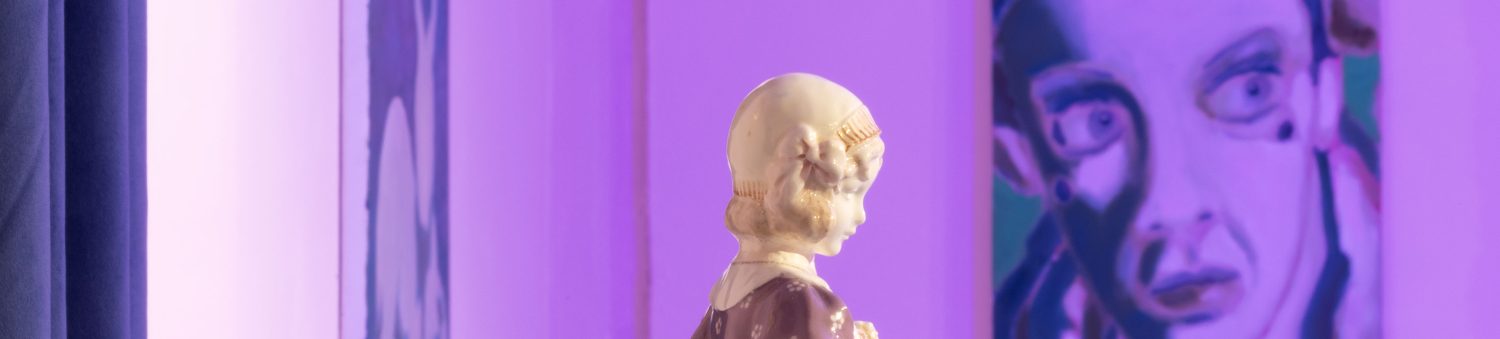
Joseph Heffernan’s upcoming show at the Royal Hibernian Academy promises to ofter a curious encounter with the artist’s own, deceptively simple Heterotopic world. ‘There were Strange Gatherings‘ presents an evolving body of work that, when taken together, forges cryptic narratives through compelling, fragmentary images. There is a strong sense of the theatrical in these staged images, which recall figures or scenarios from the commedia dell’arte, classical mythology, early modern drama and science fiction. Heffernan hones in on a playful innocence in these works without sacrificing any of the pathos of, say, Pierrot or Bottom from Shakespeare’s A Midsummer Night’s Dream. Indeed, the downcast figure in a diminutive work like The Comedian appears to contemplate something existential, while the seemingly more alert, but no less solitary focus of Genesis suggests an awakening disillusionment. Even within individual works such as these, the subject vacillates between still life (toy, ornament) and a self-aware object, conscious of its own materiality. Although heightened, this is not surrealism.
A native of Boherbue in Co Cork, Heffernan (b.1987) studied at Coláiste Stiofáin Naofa in 2005 before embarking on a BA in Fine Art at CIT Crawford College of Art & Design and a Masters in painting at the National College of Art and Design. He is an associate member of Catalyst Arts, Belfast, and was a member of Sample Studios when it opened in 2011. This artist-led studio group in Cork supports and promotes emerging and established contemporary practitioners. Perhaps underscoring the dearly held reality of illusory worlds in something like childhood play, Heffernan invites this troupe of characters – ranging from ballerinas, dolls and knights to a B-movie astronaut that, on closer inspection, proves to be a beekeeper into the Heterotopia of his studio space. The artist is interested in Foucault’s perspective on these worlds within worlds, fully realised, proposed with conviction. And Heffernan’s small studio operates in this way, as he works rapidly on a painting, sets it to one side, moves on to another, returns and reworks until the elusive thought is captured.
Often gleaned from photography or film, Heffernan’s imagery is de-contextualised and reformed through his process. In some cases, echoes of underpainting – images considered but expunged – can still be glimpsed. In a reversal of sorts from the artist’s earlier practice, layers of oil paint are worked from dark ground to light, even lurid col-ours that serve to engender the sense of unease or anxiety so central to his paintings. While varying widely in scale, often determined by choice of canvas, Heffernan’s works are orchestrated encounters with something like memory, specific yet fragmentary, allowing for recognition (even familiarity), but leaving the viewer with a relational uncertainty. Pegasus raises just such a feeling as an extreme close-up of a carousel horse or ornament confounds our sense of scale and reality. The figure appears vigorous, in motion, and yet does it await its rider, its fulfilment of purpose? Something sinister or off-kilter is at play in Heffernan’s painterly, mercurial works. But the viewer is an outsider here, watching on as the artist’s curious subjects negotiate their own worlds.
Joseph Heffernan, Royal Hibernian Academy, 12 March – 26 April
Michael Waldron is an art historian and assistant curator at Crawford Art Gallery.
 josephheffernanartist.com